21 April 2026
10:00 AM EST / 4:00 PM CET
10:00 AM EST / 4:00 PM CET
Cultivating Urbanism
TITHI SANYAL
University of Virginia
Respondent: Jessi Quizar, University of Washington
University of Virginia
Respondent: Jessi Quizar, University of Washington

Detroit's Agro-urbanity,
Detroit, USA, 2024 (Image Source: Tithi Sanyal)
For more than 130 years, Detroit has been at the forefront of urban gardening and agricultural initiatives in the United States. While French colonists established Ribbon Farms along the Detroit River in the 1700s, modern urban agriculture in Detroit has been shaped by economic struggles, population decline, ubiquity of vacant land, and food insecurity, starting with the national economic depression of 1893–97. Today, there is widespread adoption of Agroecology- “the science, practice and movement” of conservative agriculture in the city, witnessed through the proliferation of over 2280 networked urban farms and gardens. These land-based projects are enabled by initiatives and policies like the Keep Growing Detroit’s Garden Resource Program, Urban Agricultural Ordinance (2013), and the Detroit Black Farmer Land Fund (2019), which advocate for food sovereignty, particularly within African American communities and are forming an agroecological apparatus.
This talk will discuss the forces reshaping Detroit’s identity from a post-industrial city into an Agrarian City. It will demonstrate how Actor-Network Theory can serve as a methodology to examine the history of Detroit's agroecological landscape, while also examining the motivation and agency of the actors involved in the network. It will situate Detroit’s agroecological landscape within the broader trajectory of urban agriculture, highlighting its influence on urban planning and governance since the economic depression of 1893–97. At the center of this inquiry lies the question of how actants interact and what outcomes arise from these interactions that inform urban planning, design, and governance.
This talk will discuss the forces reshaping Detroit’s identity from a post-industrial city into an Agrarian City. It will demonstrate how Actor-Network Theory can serve as a methodology to examine the history of Detroit's agroecological landscape, while also examining the motivation and agency of the actors involved in the network. It will situate Detroit’s agroecological landscape within the broader trajectory of urban agriculture, highlighting its influence on urban planning and governance since the economic depression of 1893–97. At the center of this inquiry lies the question of how actants interact and what outcomes arise from these interactions that inform urban planning, design, and governance.
***
Presence, Calibration and Failure: Spatial and Knowledge Strategies in the Co-production of Drainage Infrastructures.
ALESSIO MAZZARO
Politecnico di Torino
Respondent: Matthew Kennedy, Harvard University
Politecnico di Torino
Respondent: Matthew Kennedy, Harvard University
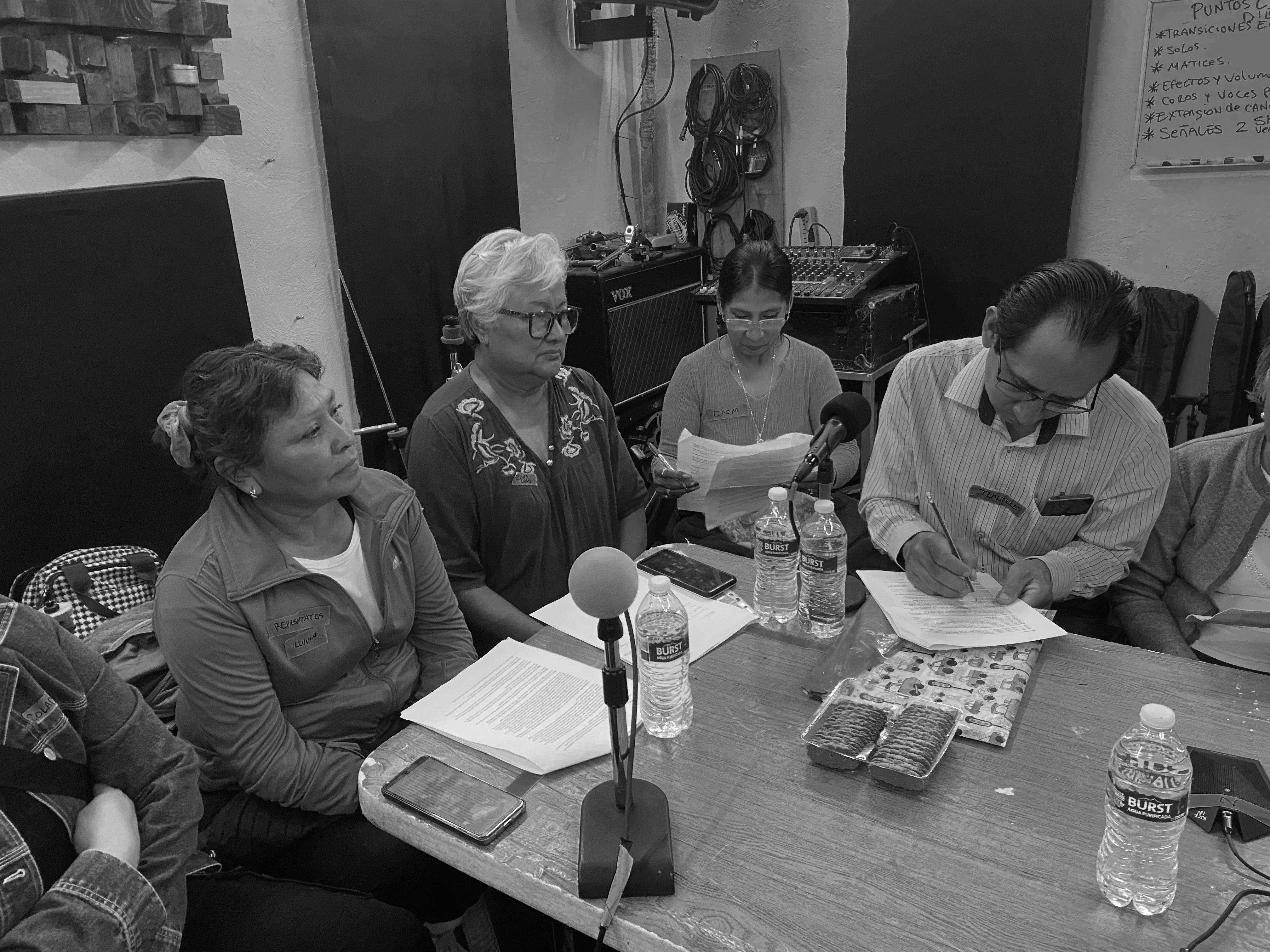
Workshop of Radionovela, July 2025, Colonia Culturas de Mexico.
The peripheries of Sao Paulo and Mexico City are territories where the alterations of water bodies, urban development, and the conflict between opposing interests and visions are so strong it may be impossible to conceive of a definitive solution to the problems related to water. Drawing on fieldwork experience and participatory art activities with inhabitants in two different case studies, this contribution examines the dynamics of co-producing knowledge and infrastructures through the categories of failure, presence, and calibration. The territory is approached as a stage where, in response to water management challenges, actions are rehearsed and revised—together with the public—by observing and learning from their effects.
In Torresmo (BZ), an informal settlement divided by a stream whose channelization increased the incidence of flooding, failure (of a drainage infrastructure, of state technicians and of a university laboratory) generates knowledge and materializes the forces at play in the territory. Here, through a list of doubts and questions (triggered by artistic activities) about a future lamination basin, residents engage with the Secretariat of Infrastructure (SIURB), contributing to exerting pressure and to voicing alternative ways of managing water in the territory.
In Colonia Culturas de México (MX), a settlement at the edge of the former Lake Chalco, a local collective dealing with the construction of a new wastewater pipe, participates in the making of the infrastructure: being present (Taylor 2020) with their bodies and questions in the construction site and conducting a practical inquiry (Dewey 1938). Monitoring in a Whatsapp group, water level and issues in the infrastructure elements, they participate in the calibration of the drainage infrastructure. Here, calibration, that is usually a technical/engineering procedure oriented toward a predetermined outcome, becomes epistemic and a collective process of relational adjustment (Latour 2005) among heterogeneous actors (engineers, inhabitants, infrastructural elements).