24 March 2026
8:00 AM EST / 1:00 PM CET
Behind Closed Doors and Windows: Constructing the Domestic Interior in Greece,
1880–1920
THODORIS CHALVATZOGLOU
National Technical University of Athens
Respondent: Anastasia Gkoliomyti, Tokyo Gakugei University, Wenzhou-Kean University
 “My Sister Penelope’s Room” Athina N. Saripolou, June 1882, watercolor,
38 × 30.5 cm. Private Collection of Athina Angelopoulou. Reproduced from Athina Saripolou-Liva: A 19th-Century Athenian Painter. Athens: Bastas–Plessas.
The scarcity of visual sources depicting urban domestic interiors in Greece from the late 19th to the early 20th century became apparent to me at the very beginning of my research. A few surviving
photographs and some scattered studies on furniture offered partial insights into spatial organization, materials, and furnishings. These allowed me to sketch a rough picture of how rooms evolved during
the period I was studying. Yet, what remained missing was a narrative—an image of how these spaces were inhabited, and by whom.
Some answers emerged with the discovery of a series of housekeeping manuals aimed at young women, at future housewives. The first, published in 1885, proved particularly revealing: such guides prescribed in detail nearly every aspect of domestic life, from cooking and hygiene to the construction and furnishing of the home. A comparative analysis of these texts provided a clearer perspective on the domestic interior, though I still had to ask to whom exactly these manuals referred. Moreover, I needed numerical data on the furniture and objects that made up an actual household of the period.
Unexpectedly, a series of legal documents—specifically dowry contracts—helped fill this gap. The dowry system, deeply embedded in Greek society, required women to bring property into marriage. The contracts I examined contained precise inventories of household furnishings, cooking utensils, and clothing allocated to brides by their families. These documents provided invaluable data for reconstructing the image of the domestic interior in which a newly married couple would live.
This paper outlines a research methodology for studying the history of the domestic interior through non-architectural texts. By drawing on disciplines such as demography, the history of emotions, and family studies, the image of what happened behind closed doors and windows becomes significantly clearer.
***
Session Not Convened
Small spaces of Morocco: Rooftop Terraces, Women and the Colonial Gaze
ZINAB HIMEUR
National School of Architecture Rabat
Respondent: Majdi Faleh, Nottingham Trent University
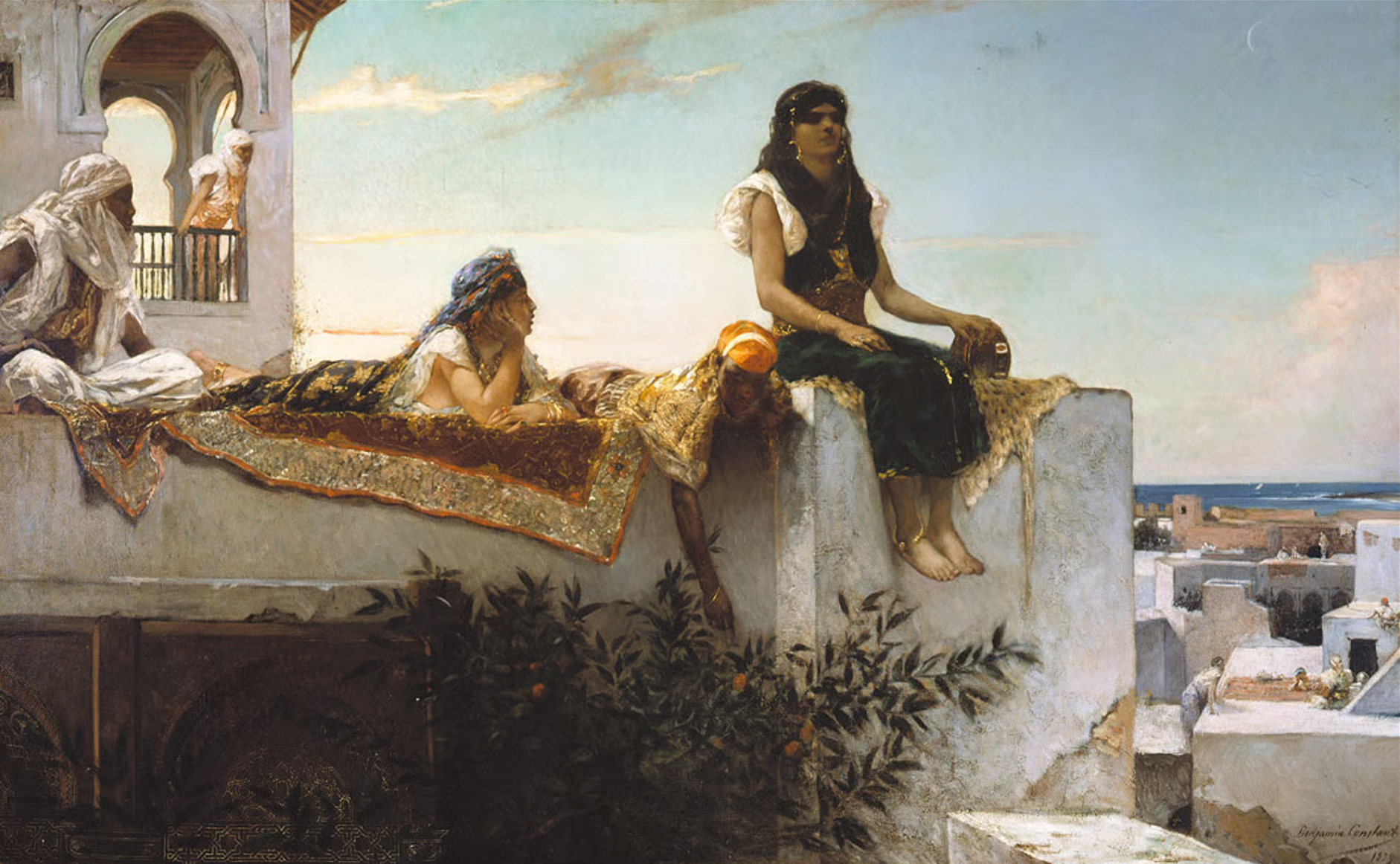 Jean Benjamin Constant – Women on rooftop terraces Tangier 1872 - Copyright Musée des Beaux Arts de Montréal (Canada)
This paper proposes a micro-historical reading of colonial Morocco through an overlooked architectural space: the rooftop terrace. Typically relegated to narrative interstices or treated as mere backdrops, rooftop terraces rarely emerge as significant spatial sites in their own right.
Building upon Swati Chattopadhyay’s work “Small Spaces: Recasting the Architecture of Empire”, this study explores how these elevated spaces were visually and culturally constructed and reconstructed, not only through urban planning and architectural form, but also within colonial literature and art, in Morocco under the French Protectorate (1912–1956).
This paper performs the archeology of these spaces, tracing how terraces mediated the encounter between colonial observers and local observed. It analyzes rooftops as thresholds between private indigenous life and the imperial gaze, where bodily visibility, modesty, and urban power relations converged. By shifting the scale from monuments to rooftops, from state plans to domestic margins, this study reveals how the Medina’s roofscape engaged in spatial politics, not only of colonial hegemony and exoticization, but also of anticolonial care and resistance.
Ultimately, this research contributes to a broader understanding of how minor spaces shaped the intimate geographies of the French colonial order, offering new ways to read colonialism, resistance and care in the architectural margins.