18 November 2025
10:00 AM EST / 4:00 PM CET
Ambition and Spectacle:
RYAN J. MITCHELL
Temple University
Respondent: Damla Göre, ETH Zurich
![]()
Mehmed Ali receiving guests at Shubra Palace in Cairo by Pascal Coste (1787-1879) in Architecture arabe; ou, Monuments du Kaire, mesurés et dessinés, de 1818 à 1826. Image: MIT Dome.
***
CATARINA FLAKSMAN
Harvard University
Respondent: Ciro Miguel, ETH Zurich
![]()
Installation photograph of brasilien baut exhibition, Zurich, Switzerland, 1954 (Museu Histórico e Diplomático / ERERIO / MRE / Mapoteca).
Between 1952 and 1960, over twenty-five exhibitions of Brazilian architecture traveled to cities around the world, from Buenos Aires to Tokyo, passing through Bogota, Lisbon, London, Zurich, Paris, Rome, Madrid, Berlin, Vienna, Brussels, and beyond. Organized by Brazil’s Ministry of Foreign Affairs, or Itamaraty, the exhibitions were part of an ambitious program to promote a modern imaginary of Brazil abroad, in turn constructing a transnational network of public and private agents and institutions. These traveling architecture exhibitions became a key instrument of cultural diplomacy, especially within the national developmentalist project that marked the presidency of Juscelino Kubitschek (1956-1961). Drawing from my ongoing dissertation, this paper investigates the international projection of Brazil’s modern architecture through a series of traveling exhibitions, shedding light on an orchestrated cultural, political, and aesthetic project of identity construction highly dependent on mechanisms of display.The investigation of these previously unstudied exhibitions suggests that architecture played a fundamental role in the cultural politics of Brazil, at home and abroad. Architecture exhibitions became a medium to construct and disseminate images and narratives aligned with the interests of the state. Based on extensive research primarily conducted in the archives of the Ministry of Foreign Affairs, the study of the exhibitions and the networks they established offers new readings of the intricate relationship between architecture, media, and politics at a time of geopolitical change during the Cold War. As a key player in Brazil’s modernization process, modern architecture was first mobilized as a tool for nation-building and, later, as part of a worldmaking project to reimagine the country’s position in the world. The display of architecture became a critical mechanism developed by the state apparatus to manifest Brazil’s anxiety to become modern, which would eventually materialize in 1960 with the construction of the country’s new capital, Brasília.
10:00 AM EST / 4:00 PM CET
Ambition and Spectacle:
The Architectural Patronage of Mehmed Ali Pasha of Egypt
RYAN J. MITCHELL
Temple University
Respondent: Damla Göre, ETH Zurich
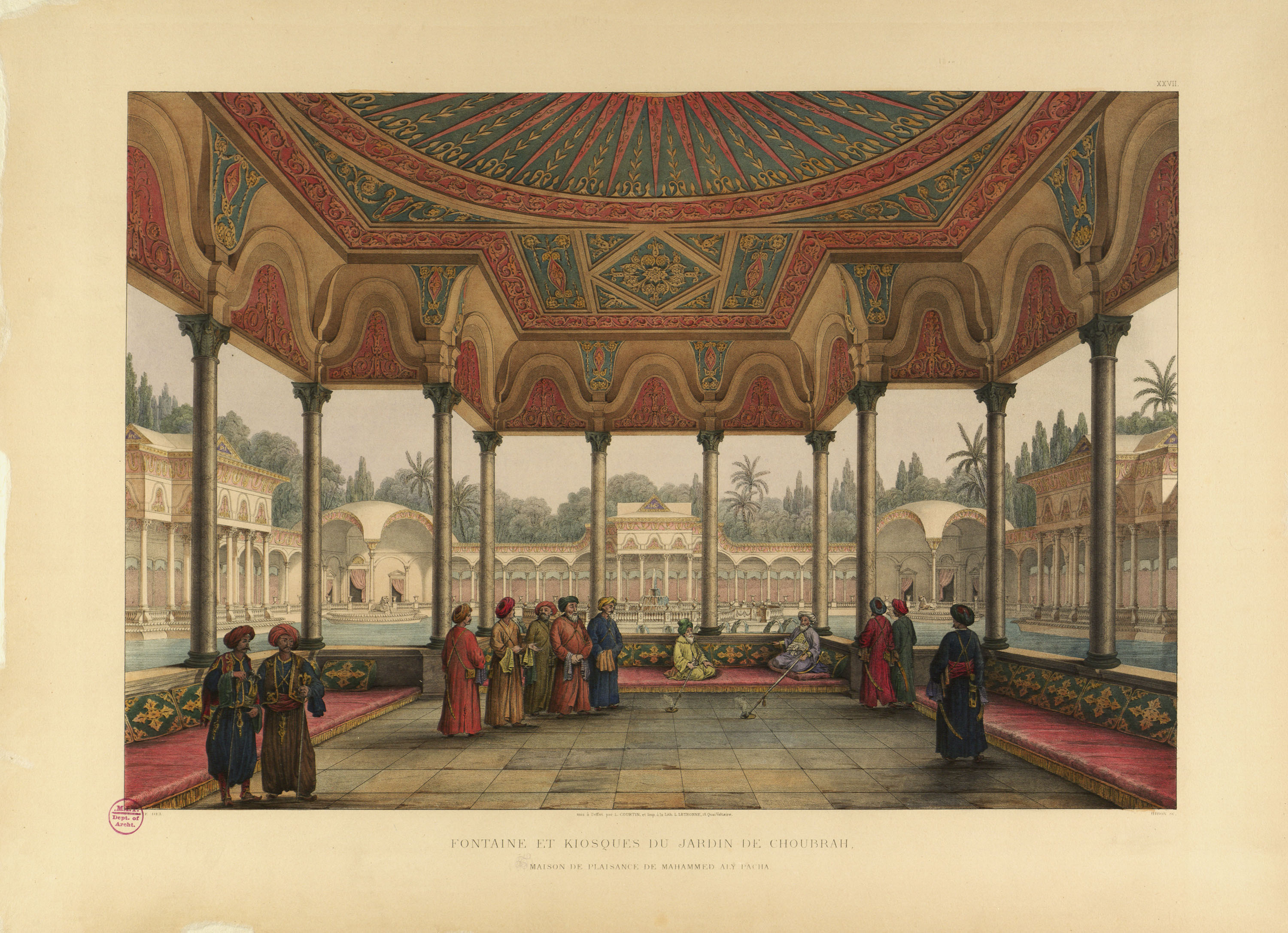
Mehmed Ali receiving guests at Shubra Palace in Cairo by Pascal Coste (1787-1879) in Architecture arabe; ou, Monuments du Kaire, mesurés et dessinés, de 1818 à 1826. Image: MIT Dome.
Mehmed Ali’s nearly forty-year reign as Ottoman governor of Egypt from 1805 until his death in 1849 profoundly transformed the province’s visual and architectural culture, which were critical tools in his modernizing initiatives that allowed Egypt to emerge as Istanbul’s primary opponent in cultural, aesthetic, and political arenas until the end of the Ottoman Empire in 1922. This talk discusses ongoing research conducted across Egypt, Greece, and Turkey that feeds a broad, comparative investigation of Mehmed Ali’s building activities in the Eastern Mediterranean. Through analysis of religious structures, palaces, industrial buildings, infrastructural projects, and institutions such as hospitals and schools, the project reconsiders definitions of center and periphery in imperial visual discourses, as well as addresses aspects of Egyptian visual culture that remain highly understudied in art historical scholarship. In addition, it contextualizes Mehmed Ali’s architectural patronage within the broader field of Ottoman architectural history in a period when much of the empire’s most dynamic building projects could be found in its provinces, often the product of powerful ayan families’ ambitions. Analyzing Mehmed Ali's patronage of such projects reveals how the governor's policies, singular will, and the socio-cultural milieu that emerged under his auspices relied heavily on visual media that allowed him to succeed in his dynasty-building ambitions.
***
Anxiety, Modernity, and Worldmaking: The Ministry of Foreign Affairs’ Traveling Exhibitions of Brazilian Architecture
CATARINA FLAKSMAN
Harvard University
Respondent: Ciro Miguel, ETH Zurich
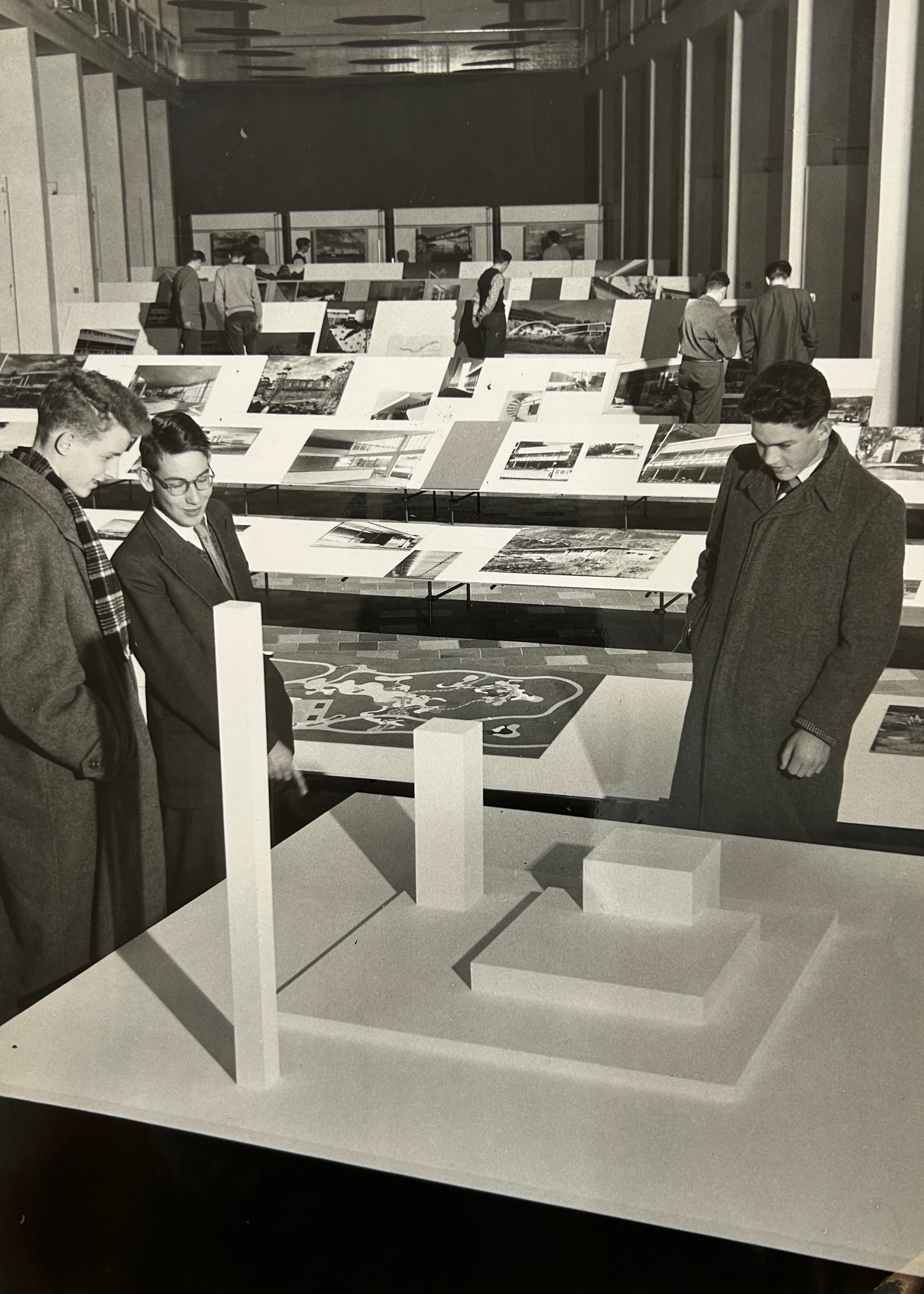
Installation photograph of brasilien baut exhibition, Zurich, Switzerland, 1954 (Museu Histórico e Diplomático / ERERIO / MRE / Mapoteca).
Between 1952 and 1960, over twenty-five exhibitions of Brazilian architecture traveled to cities around the world, from Buenos Aires to Tokyo, passing through Bogota, Lisbon, London, Zurich, Paris, Rome, Madrid, Berlin, Vienna, Brussels, and beyond. Organized by Brazil’s Ministry of Foreign Affairs, or Itamaraty, the exhibitions were part of an ambitious program to promote a modern imaginary of Brazil abroad, in turn constructing a transnational network of public and private agents and institutions. These traveling architecture exhibitions became a key instrument of cultural diplomacy, especially within the national developmentalist project that marked the presidency of Juscelino Kubitschek (1956-1961). Drawing from my ongoing dissertation, this paper investigates the international projection of Brazil’s modern architecture through a series of traveling exhibitions, shedding light on an orchestrated cultural, political, and aesthetic project of identity construction highly dependent on mechanisms of display.The investigation of these previously unstudied exhibitions suggests that architecture played a fundamental role in the cultural politics of Brazil, at home and abroad. Architecture exhibitions became a medium to construct and disseminate images and narratives aligned with the interests of the state. Based on extensive research primarily conducted in the archives of the Ministry of Foreign Affairs, the study of the exhibitions and the networks they established offers new readings of the intricate relationship between architecture, media, and politics at a time of geopolitical change during the Cold War. As a key player in Brazil’s modernization process, modern architecture was first mobilized as a tool for nation-building and, later, as part of a worldmaking project to reimagine the country’s position in the world. The display of architecture became a critical mechanism developed by the state apparatus to manifest Brazil’s anxiety to become modern, which would eventually materialize in 1960 with the construction of the country’s new capital, Brasília.